

Lacrosse, in essence, is a fairly straightforward sport that requires a few vital pieces of equipment. The most important of which are the lacrosse stick (or crosse) and the ball. Everything else is mostly meant for protection against injury. That’s not to say you shouldn’t wear protective gear, however, because it should always be on when playing. Then you have the lacrosse cleats. Sure, playing bare bones, you don’t necessarily need to have cleats to play lacrosse, but they sure are useful for providing traction as you dart up and down the field. But choosing the right cleats for you will take a bit of time and research. If you have no idea what you’re looking for yet, read through our handy guide on how to choose lacrosse cleats. It should be more than enough to get you started down the right path.
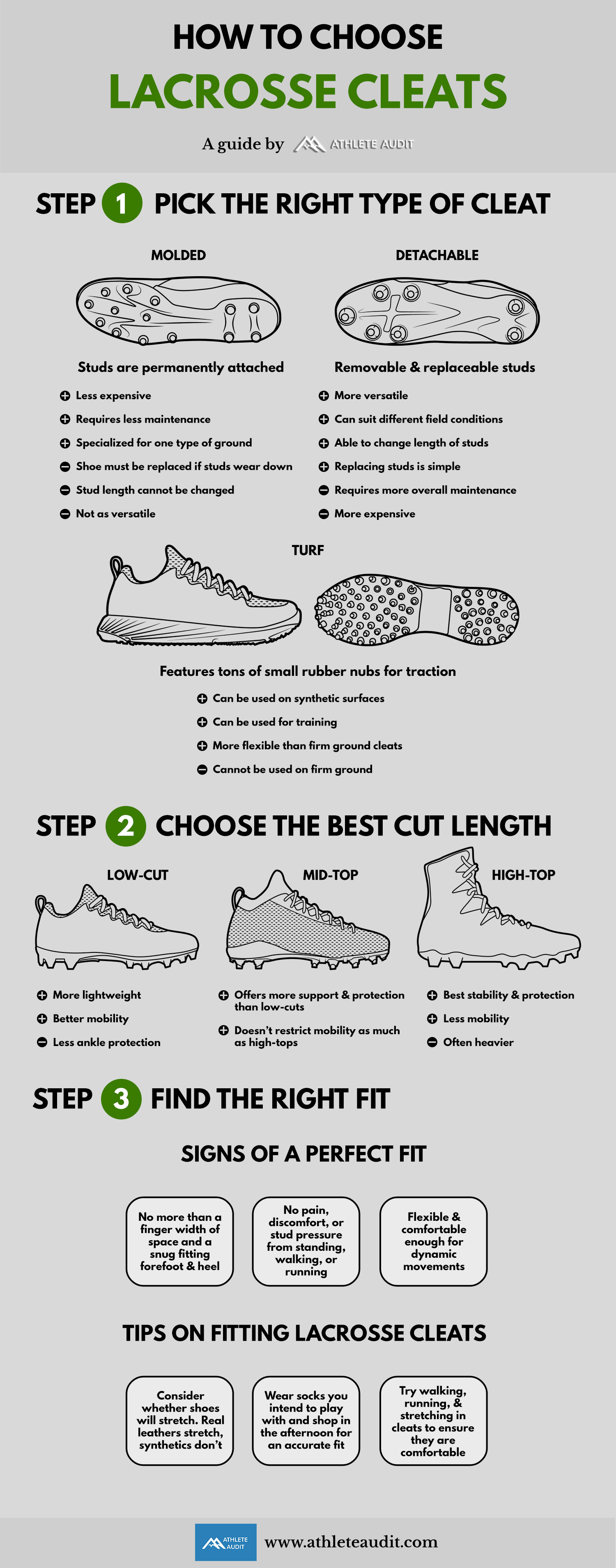
How to Choose Lacrosse Cleats Infographic
Share This Guide On Your Site
How to Choose Lacrosse Cleats: In-Depth
Step 1: Pick the Right Type of Cleat
To understand how lacrosse cleats are designed, let’s take a look at what you’re running on. Lacrosse is played on large fields of grass, and so cleats come with studs on the bottom of the sole that can dig into grass or mud to provide stability.
For natural fields, you have two options: molded or detachable studs. Studs are either made of rubber or plastic, usually with 4-6 large studs in the heel and around 8-12 in the front.
Molded - Molded cleats have studs that are permanently attached to the sole. They are less expensive, require less maintenance, and are specialized for one type of ground (ie. natural grass). The downsides to molded cleats are that the studs cannot be replaced if they wear down, the stud length can’t be changed, and they aren’t as versatile as detachable studs.
Detachable - Detachable cleats have removable and replaceable studs. They are more versatile, allowing you to adjust studs for different field conditions. Replacing studs are also incredibly simple. The disadvantages, however, are that they require more maintenance and are typically more expensive.
For those playing on turf fields or need training shoes, turf shoes are probably what you want.
Turf - The sole of a turf shoe features tons of small rubber nubs to provide traction. Turf shoes can be used on synthetic surfaces or for training. While they are more flexible than firm ground cleats, they cannot be used on firm ground.

Step 2: Choose the Best Cut Length
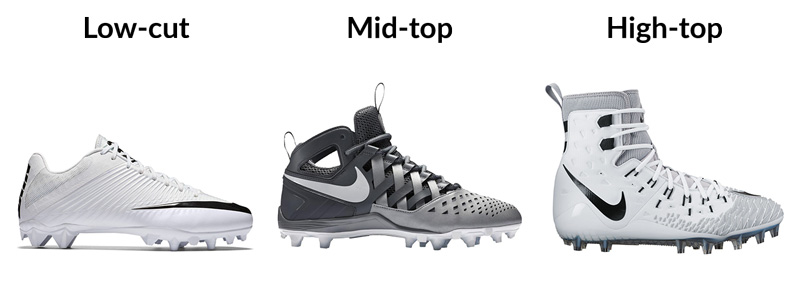
The next thing you’ll want to consider while learning how to choose lacrosse cleats is the right cut length. How high should the cleat rise above the ankle, or do you want it to sit below the ankle? There are three options to choose from, each with its own pros and cons. There are low-cut, mid-top, or high-top cleats available. The majority of lacrosse cleats will come in either low-cut or mid-top form.
Low-cuts - Low-cuts stop before the ankle and offer the most mobility for those that move around the field a lot. However, there is minimal to no ankle support and not much protection.
Mid-tops - Mid-tops sit around the ankle and provide a good balance between mobility and support/protection, although it excels at neither.
High-tops - High-tops cover the ankle and offer the most ankle support and protection, specially made for the player who requires lots of stability. However, you’ll have less mobility as a result.
Step 3: Find the Right Fit
Signs of a Perfect Fit
- No more than a finger width of space and a snug fitting forefoot and heel that doesn’t lift
- No pain, discomfort, or stud pressure from standing, walking, or running
- Flexible and comfortable enough for dynamic movements
Tips on Fitting Lacrosse Cleats
- Consider whether shoes will stretch. Real leathers stretch, synthetics don’t
- Wear socks you intend to play in and shop in the afternoon for an accurate fit
- Try walking, running, and stretching in cleats to ensure they are comfortable


